 (412) 607-8548
Does Tree Cabling and Bracing Save a Weak Limb?
Last Updated: November 17, 2026
Quick Summary
Tree cabling can save a weak limb when the limb is still sound, the cable is placed correctly, and an arborist has checked the tree first. Cables and braces support a weak part of a tree, but they do not repair rot or make a damaged tree safe forever.
- Cabling connects limbs high in the canopy, while bracing pulls a split union closed with threaded rods.
- Watch for narrow V-shaped crotches, visible cracks, cavities, fungus, or movement in the wind at the union.
- Support is worth installing only when the tree has enough healthy wood to hold the hardware.
- Cabling involves drilling, tensioning, and working at height, so it should not be a do-it-yourself project.
- Get an on-site assessment before any hardware goes in, since a cable in decayed wood can pull out under load.
Table of Contents
- What Tree Cabling and Bracing Actually Do
- Weak Branch Unions, Co-Dominant Stems, and Split Trunks
- How to Support a Weak Tree Branch: Assessment First
- Tree Cabling Techniques and Installation Boundaries
- Support, Pruning, Monitoring, or Removal: A Decision Framework
- Tree Cabling Cost and the Factors That Change Estimates
- Scheduling a Tree Cabling and Bracing Inspection
- Frequently Asked Questions
Does tree cabling and bracing save a weak limb? Often it does, but only when the limb is still sound enough to hold, the cable is placed correctly, and someone has checked the tree first. Homeowners across the Pittsburgh area often want to keep a mature tree that has a split or overextended limb. The short answer is that cables and braces support a weak part of a tree, but they do not repair rot or make a damaged tree safe forever.
Cabling and bracing are older techniques than most homeowners realize. The trick is knowing when they make sense and when they do not.
What Tree Cabling and Bracing Actually Do
Tree cabling is the installation of steel cables between two or more limbs or stems to limit how far they can move apart. Bracing usually means threaded steel rods drilled through a split or weak union to hold the pieces together. Both are forms of supplemental structural support. Neither one replaces the tree's natural strength.
A cable carries some of the load that a weak limb would otherwise carry alone. When wind pushes the limb, the cable takes up part of the movement. That can slow the spread of a crack and reduce the stress on the union where the limb joins the trunk.
Cabling versus bracing: the practical difference
Cabling connects limbs that are still mostly whole but may be overextended or likely to split apart. Bracing is used when a crack or split already runs through a union or stem, and the rods pull those pieces back together.
- Cabling: Flexible steel cables connect two limbs high in the canopy.
- Bracing: Threaded rods pass through a split union to hold it closed.
- Both: Neither method fixes decay or removes the cause of the weakness.
Weak Branch Unions, Co-Dominant Stems, and Split Trunks
Most support work targets a few common problem spots. A weak branch union is where a limb joins the trunk at a narrow angle. Narrow crotches often trap bark between the two surfaces. That trapped bark is called included bark, and it keeps the wood from growing together into a strong joint.
Co-dominant stems and multiple leaders are another common issue. These happen when a tree has two or more main stems of similar size growing from one point. Those stems can split apart as they get heavier. A split trunk or crack can sometimes be stabilized, but only if the wood around it is still healthy.
Watch for these signs of a weak union:
- A narrow V-shaped crotch between two stems
- Bark ridges pushed up or visible cracks where the stems meet
- Cavities, fungus, or soft wood near the union
- Movement or creaking when the wind blows
If you see these, a professional should look at the tree before you decide on support work.
How to Support a Weak Tree Branch: Assessment First
The most important step is an honest assessment. Support is only worth installing when the tree has enough healthy wood to hold the hardware. Installing a cable on a dead or heavily decayed limb is a waste of money and can give a false sense of safety.
A homeowner-safe assessment checklist
Use this checklist to decide whether to call a professional. Remember that a checklist is a starting point, not a substitute for an inspection.
- Is the weak limb over a house, driveway, fence, or power line?
- Is the tree otherwise healthy, with live leaves or buds on most branches?
- Does the union show a crack, split, or included bark?
- Are there any cavities, fungus, or soft spots near the weak point?
- Did the limb recently change angle or start to lean?
- Is the tree a species that handles cabling well?
If you answered yes to any of the first three questions, schedule a professional assessment. Do not climb the tree or try to install hardware yourself. Cabling involves drilling, tension, and heights that can cause serious injury.
Tree Cabling Techniques and Installation Boundaries
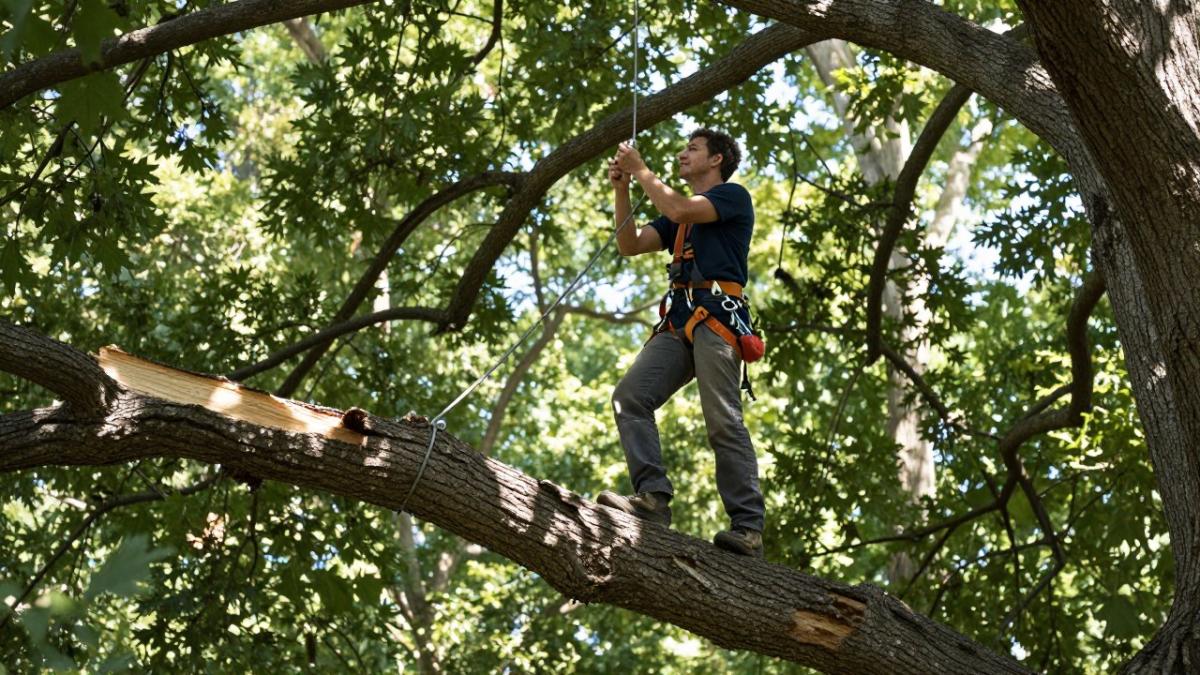
Installing a cable or brace is skilled work, and the details matter more than most homeowners expect. A certified arborist will place hardware in a way that spreads the load and avoids damaging healthy wood. The arborist will also decide where the cable sits in the canopy, how much slack it has, and whether the support needs to be adjusted over time.
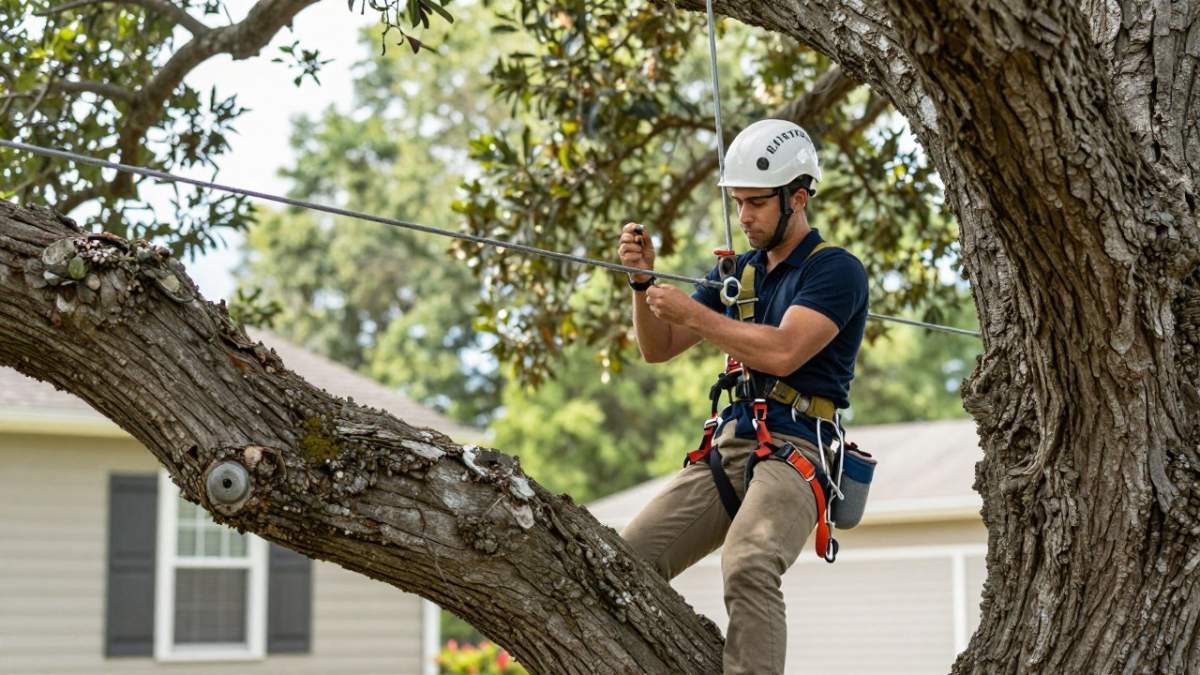
Good installation follows a few principles. Hardware should go only into sound wood. The cable should allow some natural movement, so the tree is not stiff.
What good installation actually involves
- Bracing a split: Brace rods are drilled through the union and usually paired with a cable above to share the load. The rods hold the split closed; the cable limits how far the upper limbs can move apart.
Safety boundaries every homeowner should understand
This is not a do-it-yourself project. Cabling involves drilling, tensioning, and working at height, often near power lines. The risks are serious injury, property damage, and a false sense of safety if the hardware is installed wrong.
Here are the main boundaries a homeowner should understand:
- Support cannot fix rot or decay inside the trunk.
- Cables and braces do not stop a tree from failing in extreme storms.
- Hardware needs periodic checks, since steel can corrode and wood can grow around it.
- Installation near power lines requires utility coordination, not just a ladder and a drill.
Watch out: a cable installed into decayed wood can pull out under load and turn a slow crack into a sudden failure. That is why an on-site assessment comes before any hardware goes in.
We will not promise that a cable will hold a limb through every storm.
Support, Pruning, Monitoring, or Removal: A Decision Framework
Cabling is only one option. Sometimes the better choice is different. Here is a simple way to think about it.
- Support (cabling or bracing): Best when the limb or union is still sound, the tree is healthy, and the tree has real value to you.
- Pruning: Best when the problem is an overextended limb that can be reduced in weight or length without harming the tree.
- Monitoring: Best when the risk is low and the tree is only showing early warning signs.
- Removal: Best when the tree is dead, heavily decayed, or leaning in a way that cannot be corrected.
A good assessment will look at all four options. Sometimes the best answer is to prune first and add support later. Sometimes the honest answer is that the tree should come down. Hilltop Tree Services LLC offers tree removal, trimming, and stump grinding, and can help you compare options for your property.
Tree Cabling Cost and the Factors That Change Estimates
Pricing depends on the number of cables, the height of the work, the size of the limbs, the tree species, access to the site, and whether other pruning is needed on the same visit.
The cost drivers, in plain terms
- Height and access: Taller trees and tight spaces take longer and may require specialized equipment. A tree over a driveway or near a structure is a more careful job than one in an open yard.
- Tree size and species: Larger limbs carry more load and need heavier hardware. Some species are more prone to decay at the union, which changes how much sound wood the installer has to work with.
- Condition of the tree: A tree with included bark and a clean union is a different job than one with cavities, fungus, or a visible split. Decay can rule out support entirely.
How to compare estimates
When you compare estimates, look at what each one includes. A lower bid may leave out the hardware, the inspection, the cleanup, or the follow-up checks. Ask each company whether they will assess the tree before quoting and whether they carry liability insurance.
A few questions worth asking:
- Will you assess the tree in person before quoting, or is this a phone estimate? Confirming a tree service is licensed and insured is worth doing before booking any inspection.
- What hardware do you use, and does it follow ANSI A300 Part 3?
- Does the price include a follow-up inspection, and when should I schedule it?
- Are you insured, and will you provide a certificate of insurance?
- What happens if the tree turns out not to be a good candidate for support?
Please request a quote from Hilltop Tree Services LLC to get current pricing for your specific tree.
The main cost drivers and what each one means for an estimate are summarised below.
| Cost driver | Why it matters | What it means for a quote |
|---|---|---|
| Height and access | Taller trees and tight spaces take longer | May require specialized equipment |
| Tree size and species | Larger limbs carry more load | Heavier hardware needed |
| Condition of the tree | Decay can rule out support | Clean union is simpler than a split or cavities |
| Scope of the visit | Other pruning on the same visit | Can change the total price |
Scheduling a Tree Cabling and Bracing Inspection
Start by writing down what you have seen. Note which limb is weak, what it hangs over, and when you first noticed the problem. Take a few photos from the ground. That information helps the arborist prepare for the visit.
When you are ready, request a free quote from Hilltop Tree Services LLC to have a licensed and insured crew assess the tree. Our team works directly with the homeowner, with no subcontractors.
Cabling and bracing can support a weak limb in the right situation. The safest path is to get the tree inspected first, then decide with a clear picture of what is possible.
Frequently Asked Questions
How much does tree cabling cost?
Tree cabling cost depends on the number of limbs, the tree's height, site access, hardware type, and whether an assessment or follow-up inspection is included. Pricing varies widely, so no single figure applies to every property. Hilltop Tree Services LLC provides pricing based on an on-site evaluation of your specific tree. Visit the Hilltop Tree Services LLC website or request a free quote to get current pricing for your project.
Can you install tree cabling yourself?
Installing cables or brace rods is not a reasonable DIY project for most homeowners. Correct installation requires drilling into living wood at precise angles, selecting hardware rated for the load, and working safely at height. A licensed, insured arborist should perform the work.
How often should tree cabling and bracing be inspected?
Cabling and bracing systems should be inspected periodically, and after severe storms, since hardware can loosen, corrode, or fail as the tree grows. Many arborists recommend checking support systems at least annually, with more frequent checks for older installations or trees in high-wind areas.
What is the difference between tree cabling and bracing?
Cabling uses flexible steel cables to limit how far a limb or stem can move, reducing stress on a weak union during wind or heavy loads. Bracing uses rigid threaded steel rods to hold a split union or stem together. Cabling supports weak limbs, while bracing holds split structures in place. An arborist can recommend which method fits a specific defect.


Get Your Free Quote
Join the 500+ homeowners who trust us with their tree services. Contact us to get a free quote for your project.