 (412) 607-8548

How to Safely Remove Trees Near Power Lines
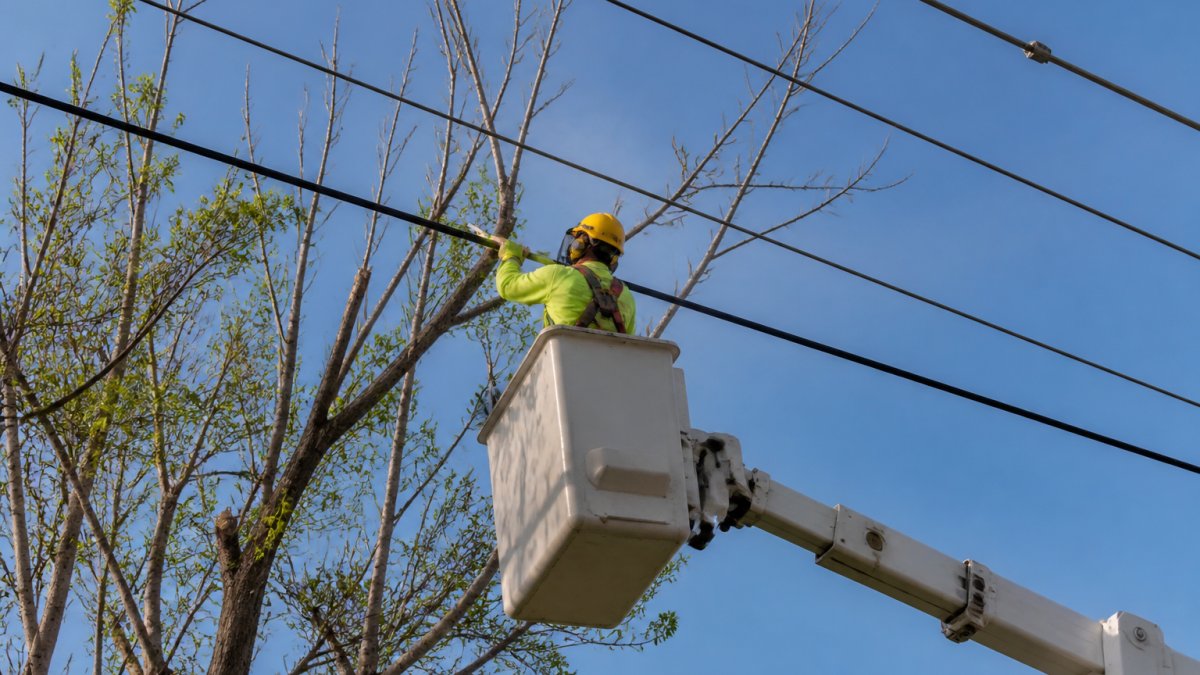
Table of Contents
- Why Trees Near Power Lines Are a Serious Hazard
- Tree Touching Power Line? What to Do Right Now
- Who to Call for Tree Near Power Lines
- Why You Should Never Trim Around Energized Lines Yourself
- Tree Trimming Around Power Lines: What a Qualified Crew Does
- Power Line Tree Clearance: How Much Space Is Enough
- Trimming vs. Full Removal: Choosing the Right Approach
- Hiring a Qualified Arborist and What to Expect During Removal
- Frequently Asked Questions
Last Updated: October 21, 2026
Why Trees Near Power Lines Are a Serious Hazard
Trees near power lines cause some of the most preventable injuries and outages in residential neighborhoods. At Hilltop Tree Services LLC, we have spent 15 years answering emergency calls that started with a limb nobody thought would fall.
The danger is not just the branch touching the wire, it is the one above it, behind it, and the dead one that looks stable until a gust hits.
How Contact Happens and What It Does
Contact usually happens in one of three ways:
- Direct contact. A limb grows into the line and stays there, energizing the whole tree.
- Conductive reach. Wet wood, a metal ladder, or a pruning pole bridges the gap.
- Indirect contact. A cut limb falls into a line on the way down, or a tree uproots and drags the line with it.
Dry wood can resist current; wet, green, or touching wood does not. That is why a tree looks safe right up until it isn't.
The result ranges from a tripped breaker to a downed conductor to electrocution. The Occupational Safety and Health Administration guidance on electrical hazards treats overhead lines as live until a utility confirms otherwise, and that rule applies to homeowners with a chainsaw just as much as to line crews.
Tree Touching Power Line? What to Do Right Now
If a tree or branch is touching a power line, assume the line is live and keep everyone at least 10 feet away. Call 911 if there is a spark, smoke, fire, or a downed wire on the ground.
Do not touch the tree, or a fence, ladder, or tool that touches it. Electricity travels through anything conductive, and the ground around a downed line can be energized in a widening circle.
Follow these steps in order:
- Move people and pets back. Shout a warning to neighbors.
- Call 911 for sparks, fire, smoke, or a wire on the ground.
- Call the utility's outage or emergency line. Report the address and what you see.
- Stay off the phone tree with neighbors until the utility clears the scene.
- Do not attempt to move the limb, even with a long pole.
Once the utility makes the scene safe, a qualified tree service steps in. Hilltop Tree Services LLC handles the tree side once the line is de-energized or confirmed clear.
Who to Call for Tree Near Power Lines
Call the utility first, then a licensed tree service. The utility owns the lines and easement; the tree service handles the wood.
That order matters: call a tree company first and the crew may arrive to an energized line and leave, costing you a trip and a day.
Utility vs. Private Property: Who Owns the Problem
Responsibility splits along the service drop. Utilities maintain clearance in the public right-of-way and along main lines; the service drop from pole to house is often the homeowner's responsibility past a certain point.
A quick way to sort it out:
| Line Type | Typical Owner | Who Clears Trees |
|---|---|---|
| High-voltage transmission lines | Utility | Utility vegetation crew |
| Distribution lines along the street | Utility | Utility or its contractor |
| Service drop to your meter | Shared, often homeowner past the pole | Homeowner hires a pro |
| Lines on your private easement | Utility holds the easement | Utility, sometimes with notice |
Rules vary by utility and state. Ask the utility directly when you call, and get the answer in writing if the tree is close to the line.
Why You Should Never Trim Around Energized Lines Yourself
Homeowners should never prune a tree within 10 feet of an energized line. Most serious tree-related electrical injuries involve people who thought the branch was far enough away.
The reasons stack up fast:
- You cannot see the current. A line looks dead. It isn't.
- Wood conducts. Green limbs and wet bark carry current.
- Ladders and poles conduct. Aluminum and fiberglass both fail at the wrong moment.
The Tree Care Industry Association safety resources is blunt about this: line clearance is a specialized job with its own training and equipment. It is not a homeowner task with a longer pole.
Tree Trimming Around Power Lines: What a Qualified Crew Does
A qualified crew plans the whole removal so nothing falls into the line, the roof, or the fence.
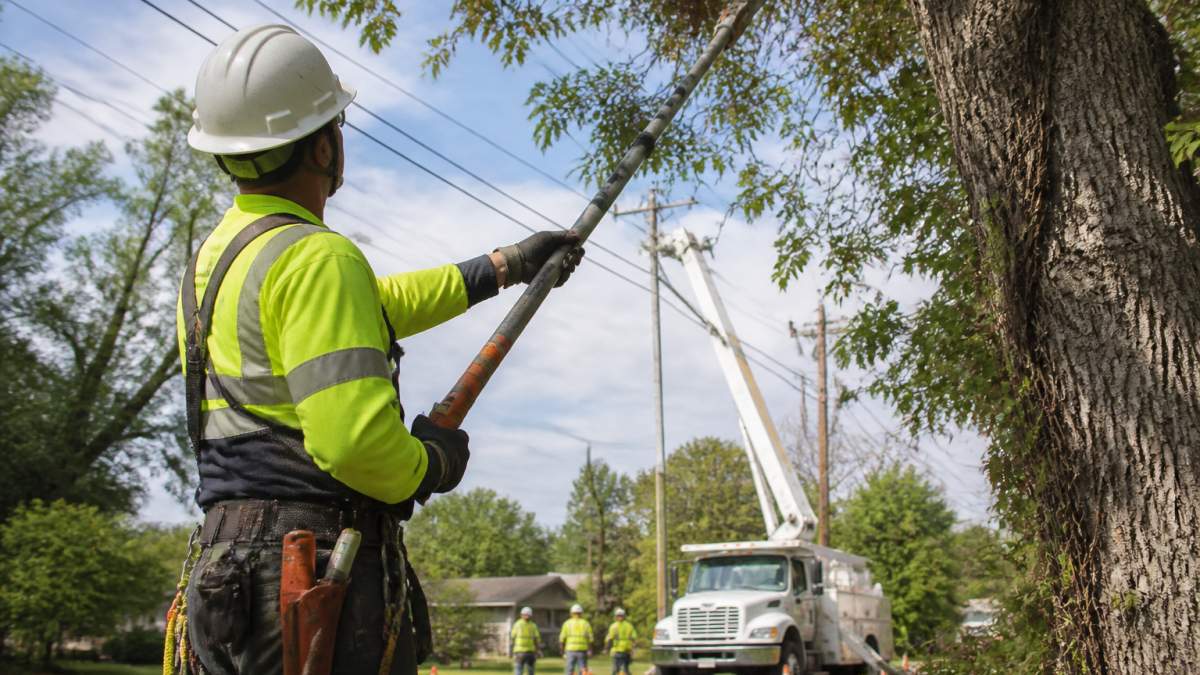
The work usually follows this sequence:
- Utility coordination. The crew confirms line status and required clearances.
- Site assessment. They check the tree's lean, root plate, and decay.
- Work zone setup. Cones, drop zone, and a spotter keep people clear.
- Sectional removal. Limbs are cut in pieces and lowered with rigging, not dropped.
- Cleanup. Brush is chipped and the site is raked.
Directional Pruning and Clearance Standards
Directional pruning removes branches growing toward the conductors and leaves those growing away, keeping the tree's shape and the line clear. It is the utility standard because it works with the tree instead of topping it.
Topping is the wrong move. It forces fast, weakly attached regrowth that reaches back toward the line within a few seasons.
Power Line Tree Clearance: How Much Space Is Enough
Clearance is measured in feet and changes with voltage, line type, and utility standards. Higher-voltage lines need more room because electricity can arc across a gap; the margin is set by the utility and state regulations, not the tree company.
How Line Type and Voltage Drive the Number
A useful way to think about it:
- Service drops and low-voltage lines. The wire from pole to meter. Clearance requirements are usually smallest, but the line is still energized and dangerous.
- Distribution lines along the street. Typically higher voltage, with wider margins, often 10 feet or more in many utility standards.
- Transmission lines. The highest voltages and widest margins, set by utility and state and federal reliability standards. Not homeowner-adjacent work zones.
The exact figure is set by the utility and state regulations. Ask the utility what applies to your line before you plan any planting or pruning, and get the answer in writing if the tree is close to the line.
How to Identify the Line Without Approaching It
You can usually tell the line type from the ground at a safe distance:
- Service drop. A single set of wires from pole to house or meter, often lower than street lines.
- Distribution line. Wires running pole to pole along the street, often with transformers on the poles.
- Transmission line. Tall steel or concrete structures, large insulators, and long spans across open corridors.
Do not approach equipment to read a tag or confirm voltage. Note the pole number, address, and what you see from a safe distance, then call the utility, it can tell you the line type and who is responsible for clearance.
Who Is Responsible for Clearance
Responsibility splits along the service drop and the easement:
| Line Type | Typical Owner | Who Clears Trees |
|---|---|---|
| High-voltage transmission lines | Utility | Utility vegetation crew |
| Distribution lines along the street | Utility | Utility or its contractor |
| Service drop to your meter | Shared, often homeowner past the pole | Homeowner hires a pro |
| Lines on your private easement | Utility holds the easement | Utility, sometimes with notice |
Rules vary by utility and state. Ask the utility directly when you call, and get the answer in writing if the tree is close to the line. If the utility says the tree is on your side of the responsibility line, that is when a qualified tree service steps in, after the utility confirms line status.
Trimming vs. Full Removal: Choosing the Right Approach
Trimming is the right call when the tree is healthy and the problem is one or two limbs. Removal is the right call when the tree is dead, leaning, storm-damaged, or too close to regrow into the line.
Use this checklist to sort it out:
- Is more than a quarter of the crown affected?
- Is the trunk hollow, cracked, or leaning toward the line?
- Has the tree already been topped or badly pruned?
Two or more checks means removal is usually the safer and cheaper long-term choice. Repeated trimming on a fast grower adds up.
Hiring a Qualified Arborist and What to Expect During Removal
Hire a licensed, insured tree service with documented line-clearance experience, and verify every claim before work starts. The cheapest quote often skips insurance, and that cost lands on you.
Credentials, Insurance, and Liability to Verify
Ask for four things in writing and confirm each independently:
- License. Confirm it is current and matches the legal company name on the quote. Check the state licensing board or contractor registry directly rather than a photo of a card.
- General liability insurance. Request a certificate naming the policyholder, coverage limits, and effective dates. Call the agent listed on the certificate, not the number the contractor gives you, to confirm it is active.
- Workers' compensation. If a crew member is injured on your property and the company carries no workers' comp, you can be exposed. Confirm coverage is in force for your state.
Also ask whether the company uses subcontractors. If it does, the crew that quotes the job may not be the crew that shows up, and the insurance you verified may not cover the actual workers.
What a Professional Assessment Covers
A credible assessment happens before any saw starts. Expect the arborist to walk the property and document:
- Tree condition. Species, lean, root-plate stability, hollows, cracks, included bark, and deadwood that could fail into the line.
- Line type and status. Whether the line is a service drop, distribution line, or transmission line, who owns it, and what the utility has authorized.
- Drop zone and targets. Where limbs will land, what structures or vehicles are in the fall path, and whether a crane or rigging is needed.
- Access. Where the bucket truck or chipper can stage, whether gates or fences must be removed, and how the work zone stays clear of people and pets.
- Permits. Whether the jurisdiction requires a tree-removal permit, right-of-way permit, or historic-district review. Permit rules vary widely; the contractor should know the local requirement or tell you to confirm it.
- Utility coordination. Whether the utility must de-energize, install cover-up, or schedule a line crew, and what notice it requires.
The Removal Sequence, Step by Step
Once the assessment is complete and the utility has confirmed line status, the work typically follows this order:
- Utility confirmation. The crew verifies the line is de-energized or that protective cover-up is installed, and confirms required clearances.
- Work-zone setup. Cones, caution tape, a drop zone, and a spotter keep people and pets clear. The crew identifies an escape route for every cut.
- Sectional removal. Limbs are cut in pieces and lowered with rigging rather than dropped; the trunk is cut in sections from the top down.
- Rigging and lowering. Ropes and friction devices control each piece's descent so nothing swings into the line, roof, or fence.
- Stump grinding and cleanup. The stump is ground below grade, brush is chipped, and the site is raked. Ask in advance whether stump grinding and haul-away are included or priced separately.
Permits, Liability, and Who Pays If Something Goes Wrong
Permits are local. Many municipalities require one to remove a tree above a certain trunk diameter or in a right-of-way, and some require a utility-approved plan near lines.
Liability follows insurance. If a contractor damages your roof, fence, or a neighbor's property, the general liability policy should respond, but only if it is active and the work is within scope.
At Hilltop Tree Services LLC, we do not use subcontractors, so the crew that quotes your job is the crew that shows up. We are licensed and insured, and we have served more than 500 customers. You get direct communication with the people doing the work.
Frequently Asked Questions
Can I remove a tree that is touching a power line?
No. A tree in contact with an energized line can carry current into the trunk, branches, and even the ground around it. Do not touch the tree, do not stand under it, and keep others away. Call your electric utility first to report the contact and ask them to assess the line. Only a qualified line-clearance arborist or the utility crew should work on trees near power lines. Attempting removal yourself risks electrocution and serious injury.
Who is responsible for trimming trees near power lines?
Responsibility depends on where the tree sits. Utilities typically maintain clearance along their rights-of-way and easements, which is why you may see crews pruning along the street. Trees on your private property are usually the homeowner's responsibility, even when branches reach toward the lines. Call the utility to confirm what they cover, then hire a qualified arborist for work on your side of the property line. Never assume the utility will handle a private tree.
How far should trees be from power lines?
Clearance requirements vary by utility and by line voltage, so there is no single number that fits every property. Distribution lines generally need more open space than service drops, and taller species need more room as they mature. Your utility's vegetation management department can tell you the standard for your area. When planting, choose species with a mature height that stays well below the lines, and site them far enough that future growth will not reach the conductors.
What should I do if a tree falls on a power line?
Treat every downed line as energized. Stay at least a full bus length away, keep children and pets back, and do not touch the tree, the line, or anything in contact with them. Call 911 if there is fire, injury, or a line across a road, then call your utility's emergency number. Do not attempt to move branches or drive over the line. Wait for the utility crew to de-energize and clear the line before any tree work begins.


Get Your Free Quote
Join the 500+ homeowners who trust us with their tree services. Contact us to get a free quote for your project.


