 (412) 607-8548

Signs a Mature Tree Needs Removal: 7 Warning Signs
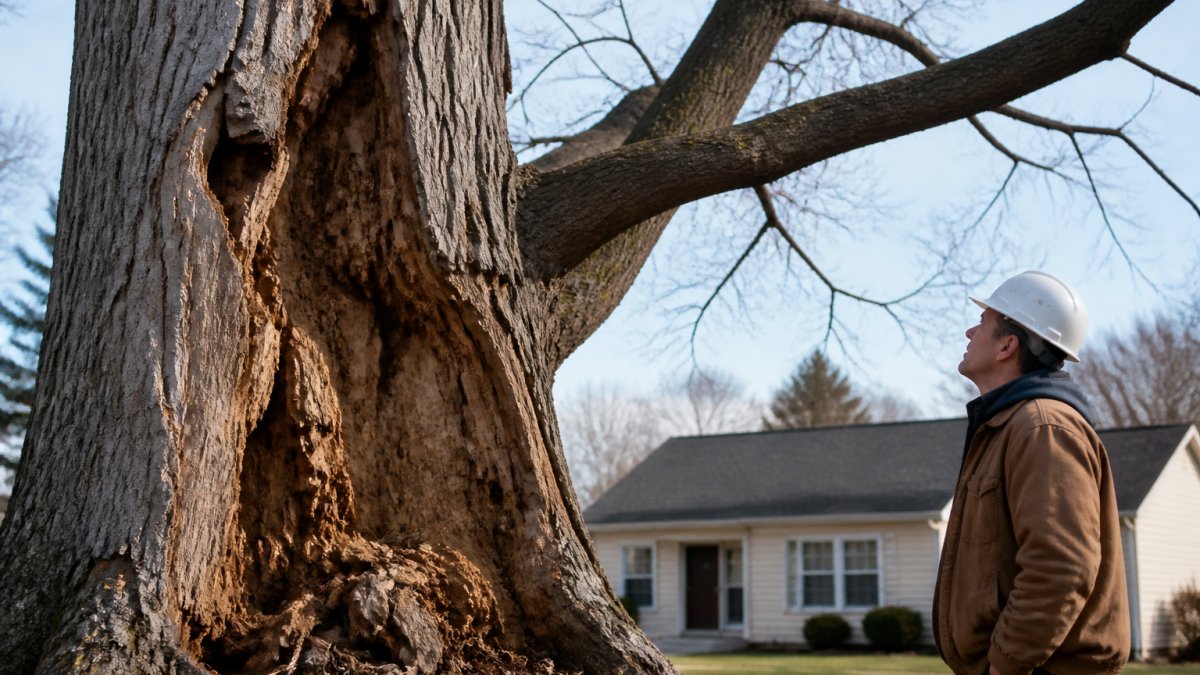
Table of Contents
- How to Spot the Signs a Mature Tree Needs Removal
- Signs a Tree Is Dying: Dead Branches, Leaf Loss, and Canopy Decline
- Tree Trunk Decay and Cavities: What Vertical Cracks and Soft Wood Mean
- Tree Root Damage and Instability: Exposed Roots, Soil Erosion, and Leaning Trees
- Storm Damage, Broken Limbs, and Fungal Growth
- Arborist Tree Risk Assessment: When to Call a Professional
- Removal vs. Alternatives: Pruning, Cabling, and Treatment
- What Happens After Removal: Stump Grinding and Site Cleanup
- Frequently Asked Questions
Last Updated: October 17, 2026
How to Spot the Signs a Mature Tree Needs Removal
A mature tree needs removal when it shows structural failure, dead or hollow wood, root instability, or damage that puts people and property at risk.
Below, we'll walk you through the signs a mature tree needs removal, in the order we check them on a site visit. Some are obvious. Others take a trained eye.
Here's what most guides get wrong: they treat every dead branch as a death sentence. It isn't. A tree can lose limbs and live for decades.
Signs a Tree Is Dying: Dead Branches, Leaf Loss, and Canopy Decline
The clearest sign a tree is dying is a canopy that thins from the top down while the lower branches stay green. That pattern points to a tree health problem in the root system or main stem, not just seasonal leaf drop.
Watch for these clues:
- Dead branches that snap cleanly and show no green under the bark
- Leaf discoloration out of season, especially yellowing in summer
- Branch dieback moving inward from the tips
- A sparse canopy compared to nearby trees of the same species
Deadwood and Hanging Limbs
Hanging limbs are the most urgent item on any tree inspection. A dead branch over a roof, driveway, or power line is a falling-tree risk the moment wind picks up.
Look for deadwood that's brittle, gray, or missing bark. If a limb is cracked at the collar where it meets the trunk, don't wait. Call a tree-care professional.
Leaf Discoloration and Branch Dieback
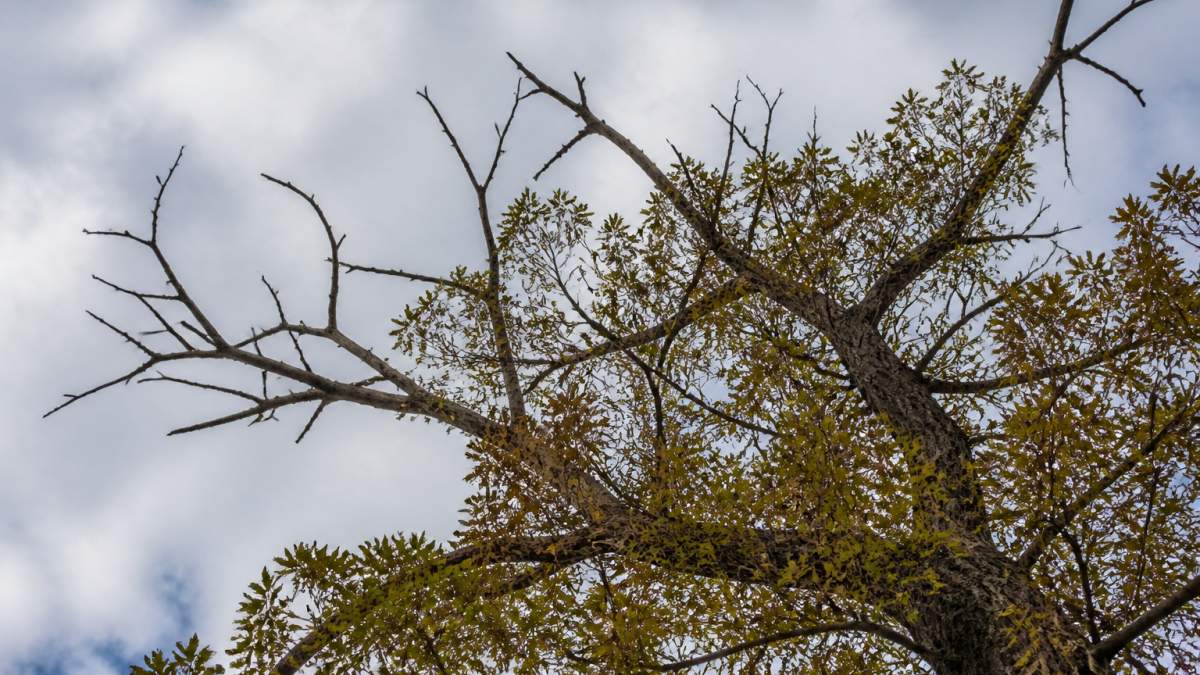
Some yellowing is normal in fall. Yellowing in July is not. Disease and pests often show up first as leaf discoloration on one side of the tree.
Branch dieback tells the same story from the inside out. When the tips die back year after year, the tree is losing its ability to move water and nutrients. That's tree decline, and it rarely reverses on its own.
Tree Trunk Decay and Cavities: What Vertical Cracks and Soft Wood Mean
Tree trunk decay and cavities are the most serious structural defect we find, because the trunk is the tree's load-bearing column. A hollow or soft main stem can fail with no warning at all.
Here's what to check at eye level:
- Vertical cracks or seams running up the trunk
- Cavities where water collects and wood rots
- Soft wood that gives when pushed with a probe
- Fungal growth at the base or on old wounds
Cracks, Seams, and Hollow Wood
A single vertical crack can be harmless. Two cracks on opposite sides of the trunk, or a seam that runs deep, is a different story. That pattern often means internal decay has split the wood.
Hollow wood is common in old trees and not always fatal. But when a hollow trunk sits near a house or driveway, the risk assessment changes fast. We treat hollow trees over targets as hazardous until proven otherwise.
Tree Root Damage and Instability: Exposed Roots, Soil Erosion, and Leaning Trees
Tree root damage and instability are the hardest problems to see, because the root system sits underground. The visible clues show up at the base and in how the tree stands.
Signs to watch for:
- Exposed roots lifted above the soil line
- Soil erosion or a gap on one side of the trunk
- A leaning tree that wasn't leaning before
- Cracks in the soil radiating from the base
A leaning tree is a genuine safety hazard when the lean is new or getting worse.
If the ground around the trunk feels spongy or you see mushrooms at the base, root damage is likely. That's a call-a-professional moment, not a wait-and-see one.
Storm Damage, Broken Limbs, and Fungal Growth
Storm damage is the fastest way a healthy tree becomes a hazardous tree. Broken limbs, split trunks, and torn bark all weaken the structure, even when the tree still looks green.
After a storm, check for:
- Broken limbs still hung up in the canopy
- Split crotches where two leaders pull apart
- Torn bark exposing bare wood
- Fungal growth on fresh wounds
Mushrooms near the trunk or roots are a red flag for internal decay. Fungal growth means the tree is breaking down wood somewhere you can't see.
For guidance on how to assess a tree safely from the ground, the International Society of Arboriculture's tree risk resources are a solid reference.
Arborist Tree Risk Assessment: When to Call a Professional
An arborist tree risk assessment is a structured inspection that rates a tree's likelihood of failure and what it could hit. It's the difference between guessing and knowing. Most top-ranking guides stop at a list of warning signs.
A tree-care professional checks the trunk, roots, canopy, and site conditions. They look at targets: the house, the driveway, the power line, the neighbor's fence. Then they weigh the risk. You can do a simplified version of the same assessment from the ground, without climbing or running unsafe tests.
A Practical Homeowner Risk-Assessment Checklist
Use this checklist to decide whether to call. It separates the three parts of risk so you're not treating every defect as an emergency.
1. Identify the target (what could be hit)
- A house, garage, shed, or other structure
- A driveway, walkway, patio, or deck
- A power line, cable, or utility box
- A fence, retaining wall, or landscape feature
- A neighbor's property or a shared boundary
- People or pets that regularly use the area
2. Look for signs that raise the likelihood of failure
- Dead or hanging limbs over a target
- Vertical cracks or seams in the trunk
- Cavities, soft wood, or mushrooms at the base
- A new lean or exposed, lifted roots
- Soil erosion or a gap on one side of the trunk
- Storm damage with broken limbs still in the tree
- More than one major sign at the same time
3. Weigh the consequences
- Would failure cause injury or death?
- Would it damage a structure or vehicle?
- Would it block an exit or access route?
- Would it take down a utility line?
A tree with a large target and two or more failure signs is a high-priority call. A tree with a minor target and one sign can usually wait for a scheduled inspection.
At Hilltop Tree Services LLC, our licensed and insured team handles the assessment and the work, with no subcontractors. You talk directly to the crew doing the job.
Removal vs. Alternatives: Pruning, Cabling, and Treatment
Removal isn't always the answer. Pruning, cabling, and treatment can save a tree when the damage is limited and the structure is sound. The key is matching the remedy to the defect, not treating every problem as a removal decision. Here's how the alternatives compare, and when each one stops being viable.
| Option | Best For | When It Works | When It Doesn't |
|---|---|---|---|
| Pruning | Deadwood, overgrowth, minor crown defects | Tree is otherwise healthy and the trunk is sound | Trunk is hollow, cracked, or extensively decayed |
| Cabling | Split or weak crotches, co-dominant leaders | Sound wood around the weak point and a manageable target | Widespread decay or root instability |
| Treatment | Pests, disease, nutrient deficiency | Caught early, before advanced decline | Advanced decline or structural damage |
| Removal | Structural failure, root instability, hazardous defects | Risk to people or property can't be mitigated | Tree can't be made safe with reasonable measures |
The decision comes down to risk and targets. A tree with one weak limb and a sound trunk is a pruning or cabling candidate. A hollow, leaning tree over a house is a removal decision.
How to Tell Which Warning Signs Call for Removal
Not every sign carries the same weight. Use this guide to separate the manageable from the removal-level.
Signs that may be managed with pruning or cabling:
- A single dead limb with a sound trunk and no target below
- A weak crotch with sound wood on both sides
- Overgrowth or crossing branches
- Minor storm damage with no split trunk
Signs that usually point to removal:
- A hollow or soft trunk near a target
- A new lean or exposed, lifted roots
- Multiple vertical cracks or seams
- Mushrooms at the base combined with storm damage
- Root instability after construction or grading
For guidance on how to assess a tree safely from the ground, the International Society of Arboriculture's tree risk resources are a solid reference.
What Happens After Removal: Stump Grinding and Site Cleanup
Stump grinding and site cleanup are the last steps, and they matter more than most homeowners expect. A removal isn't finished until the stump is gone and the site is clear.
Grinding depth depends on what you plan to do with the space.
Here's what a complete job should include:
- Stump ground to an agreed depth, roots included
- Debris and brush hauled away or piled as requested
- The site raked and left clean
- A clear walkthrough before the crew leaves
Customers tell us cleanup is where a lot of tree services fall short.
After removal, watch the site for a season. Fill any settling soil, and keep an eye on nearby trees that shared a root zone.
Frequently Asked Questions
What are the first signs that a mature tree needs to be removed?
The earliest warning signs often include dead or dying branches, leaf discoloration, and a thinning canopy. You may also notice vertical cracks in the trunk, mushrooms growing near the base, or exposed roots. A leaning tree that has shifted position is another red flag. If you spot any of these, a professional tree inspection can confirm whether the tree is a safety hazard or can be saved with pruning or treatment.
Can a tree with a hollow trunk be saved?
Sometimes a tree with a hollow trunk can be preserved if the hollow is small and the tree shows vigorous growth. However, large cavities, soft wood, or multiple cracks often mean the tree is structurally compromised and may fail. An arborist can perform a risk assessment to determine if cabling or bracing could help, but removal is often the safest choice when internal decay is extensive.
Does a leaning tree always need to be removed?
Not always. A tree that has leaned gradually over many years may be stable, especially if it has a healthy root system. But a sudden lean, especially after a storm, often indicates root damage or soil failure and is a serious hazard. Look for exposed roots, cracked soil, or a new tilt. When in doubt, call a tree-care professional for an assessment before the tree falls on its own.
How do I know if I need an arborist tree risk assessment?
If you see any major structural defect, such as trunk cracks, cavities, fungal growth, or root instability, an arborist tree risk assessment is warranted. Also, if the tree is large and near your home, power lines, or a frequently used area, a professional evaluation can quantify the risk. Arborists use specialized tools and experience to identify hidden decay and recommend the best course of action, whether that's removal or mitigation.
A mature tree that's leaning, hollow, or dropping limbs is a problem you can't put off. Hilltop Tree Services LLC brings over 15 years of experience, a licensed and insured team, and no subcontractors to every job, from a single hazardous tree to wooded acreage and brush clearing. We handle safe removal, precise pruning, and stump grinding, then leave the site clean. Get started with Hilltop Tree Services LLC and get a free quote on your property today.


Get Your Free Quote
Join the 500+ homeowners who trust us with their tree services. Contact us to get a free quote for your project.


