 (412) 607-8548

Stump Grinding Cost: What to Expect in 2026
Last Updated: October 23, 2026
Quick Summary
Stump grinding cost ranges from $120 to $1,600 depending on stump size, wood type, and site conditions. The national average for a single stump falls between $307 and $426, with most contractors charging $2 to $6 per inch of diameter plus a minimum service charge of $80 to $160.
- Small stumps under 12 inches cost $250 to $400; large stumps over 24 inches cost $800 to $1,600 or more.
- Hardwood stumps incur a 25% to 50% surcharge compared to softwood due to density and grinding time.
- Most contractors charge per stump with a minimum fee, making multiple stumps more cost-effective per unit.
- Standard grinding depth is 4 to 6 inches below ground; deeper grinding adds significant cost.
- Difficult site access, steep terrain, or obstacles can increase estimates by 50% or more due to equipment limitations.
Table of Contents
- Understanding Stump Grinding Cost
- National Average Stump Grinding Pricing
- Stump Grinding Cost Factors That Affect Your Estimate
- Using a Stump Grinding Cost Calculator and Estimate Template
- How Long Does Stump Grinding Take and What's Included
- Creating Your Stump Grinding Estimate Template
- Single Stump vs. Multiple Stumps: Pricing Strategy
- When DIY Rental Makes Sense vs. Hiring a Professional
- Frequently Asked Questions
Understanding Stump Grinding Cost
Stump grinding cost estimates vary widely depending on what you're grinding, where it's located, and how deep you need to go. Understanding the factors that drive pricing helps you compare quotes accurately and avoid surprises.
The real challenge isn't finding someone to grind a stump, it's knowing whether a quote is fair.
This guide walks you through how stump grinding is priced, what drives those costs up or down, and how to request comparable quotes so you're not caught off guard.
National Average Stump Grinding Pricing
According to Thumbtack's 2026 cost data, the national average range to grind one stump falls between $307 and $426. That's a useful benchmark, but it masks significant regional and job-specific variation. The reason?
Angi's 2026 pricing guide reports that a standard stump-grinding job costs $120 to $400, with large-diameter stumps reaching $1,600 or more. The spread reflects the reality that a 6-inch stump and a 48-inch stump are entirely different jobs requiring different equipment and time investment.
Per-Stump Pricing vs. Hourly Rates
Most contractors price stump grinding one of two ways: per stump or by the hour. Understanding the difference matters because it changes how you should evaluate competing quotes.
Per-stump pricing is the most common model. This approach works well when you have one or two stumps and want predictability. HomeGuide's 2026 stump grinding cost analysis notes that per-inch pricing typically ranges from $2 to $6 per inch of diameter, which translates to a simple calculation once you know your stump size.
Hourly rates are less common but appear when site conditions are complex or multiple stumps require custom sequencing. An hourly model protects the contractor if the job takes longer than expected but can feel uncertain to the homeowner. Most contractors won't quote hourly unless they've already assessed the site.
Minimum Service Charges
Here's where many homeowners get surprised: contractors impose minimum charges because mobilizing equipment and crew has a fixed cost regardless of stump size. That $80 to $160 minimum means a small stump in your front yard might cost the same as a slightly larger one because you're paying for the service call, not just the grinding time.
This is why multiple stumps make financial sense. Once a crew is on-site with equipment, grinding a second stump costs far less than the first. The minimum applies once per visit, not per stump.
Stump Grinding Cost Factors That Affect Your Estimate
Several variables shift your stump grinding cost estimate, sometimes dramatically. Knowing these factors helps you understand why two quotes for "stump removal" can differ by $300 or more.
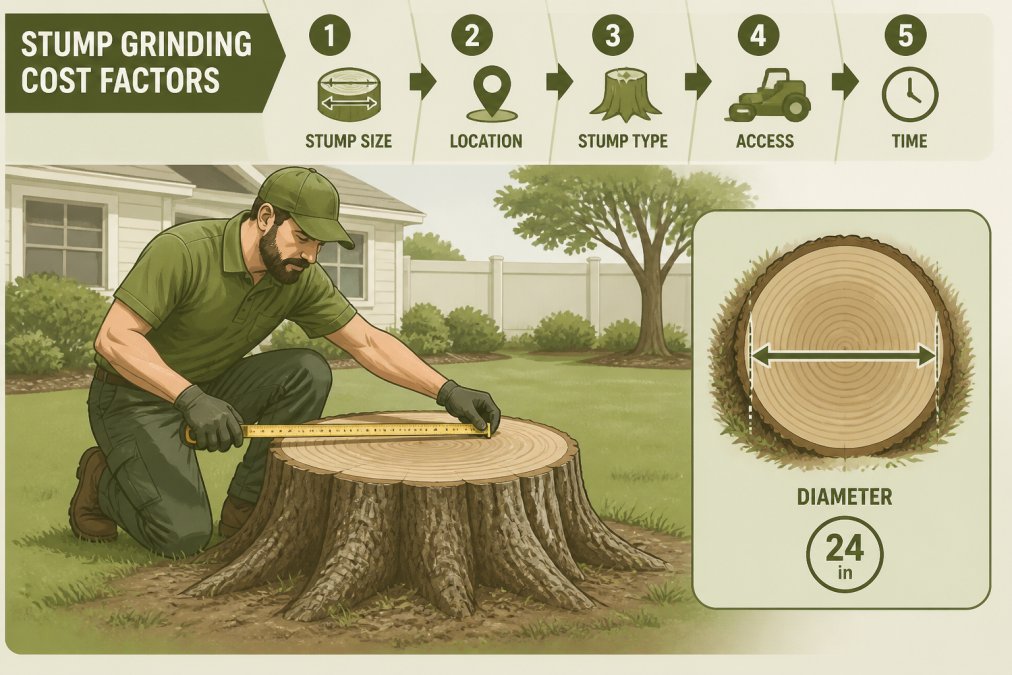
Stump Diameter and Size Categories
Stump size is the primary cost driver. Contractors typically categorize stumps into ranges, and your stump grinding cost jumps at each threshold.
Small stumps (up to 12 inches in diameter) usually cost $250 to $400. These grind quickly and don't require heavy equipment.
Medium stumps (12 to 24 inches) typically cost $400 to $800. A 24-inch stump averages around $275 according to Tree Cost Removal Calculator's 2026 benchmarks.
Large stumps (over 24 inches) cost $800 to $1,600 or more. A 72-inch stump can reach $395 to $600 depending on wood type and site conditions.
Wood Type: Hardwood vs. Softwood Surcharges
Not all wood grinds the same. Softwoods like pine and fir grind relatively quickly. Hardwoods like oak, maple, and hickory are denser and require more grinding time, more blade wear, and sometimes specialized equipment.
Expect a 25% to 50% surcharge for hardwood stumps. A softwood stump might cost $300, while an identical-sized hardwood stump costs $400 to $450.
The problem is that homeowners often don't know what species they're grinding. If you're unsure, take a photo of the bark and cross-section (if visible) and ask your contractor to identify it. That conversation prevents quote disputes later.
Site Access and Difficult Terrain
Equipment access is a hidden cost multiplier. A stump in an open yard with a wide driveway costs less to grind than one wedged between your house and your neighbor's fence, or one on a steep hillside.
Difficult access can add to your estimate. If the grinding equipment can't reach the stump directly, contractors must use smaller handheld grinders or mini loaders, both of which are slower and more labor-intensive.
Before requesting quotes, note whether your stump is easily accessible or poses challenges. Contractors will ask, and your answer affects the estimate.
Grinding Depth and Service Scope
Most standard stump grinding goes 4 to 6 inches below ground level, leaving the root system intact. If you need deeper grinding to eliminate surface roots or prepare for landscaping, that's an add-on.
Full stump removal, grinding to 12 inches or deeper, costs significantly more. It requires more grinding time and often means disposing of additional wood chips.
Clarify depth expectations before accepting a quote. If you're planning to plant or build on the site, you may need deeper grinding than the contractor's default.
Using a Stump Grinding Cost Calculator and Estimate Template
Requesting quotes is easier when you know what information contractors need and how to frame your request for consistency.
How to Measure Your Stump and Request Comparable Quotes
Start by measuring your stump diameter at ground level using a measuring tape. Measure across the widest point, then measure perpendicular to that.
Next, identify the wood type if possible. Look at the bark and any exposed grain. Softwoods typically have lighter, softer bark. Hardwoods have thicker, rougher bark.
Finally, assess site access. Can a truck with a grinding rig drive to within 20 feet of the stump? Is the ground level or sloped?
When you contact contractors, provide this information: stump diameter, estimated wood type, grinding depth required, site access description, and number of stumps.
Sample Itemized Estimate Breakdown
Here's what a transparent stump grinding cost estimate should include:
| Line Item | Details | Cost |
|---|---|---|
| Base service (1 stump, standard depth) | Up to 24-inch diameter, softwood | $350 |
| Hardwood surcharge | Oak stump, +40% | $140 |
| Difficult site access | Mini loader required, +50% | $245 |
| Debris removal and cleanup | Wood chips hauled, site cleared | $75 |
| Total Estimate | 3 stumps, mixed sizes | $810 |
A good estimate breaks down labor, equipment, materials, and any add-ons. If a contractor gives you a single number with no detail, ask for an itemized breakdown. Transparency builds confidence.
How Long Does Stump Grinding Take and What's Included
Understanding the timeline and scope of work prevents misaligned expectations.
Typical Timeline by Stump Size
A small stump (under 12 inches) typically takes 15 to 30 minutes to grind, not counting setup and cleanup. Medium stumps (12 to 24 inches) take 30 minutes to an hour. Large stumps (over 24 inches) can take 1 to 3 hours or more, especially if they're hardwood or deeply rooted.
These times assume straightforward site access and standard grinding depth. Difficult access or deeper grinding extends the timeline. Multiple stumps on the same property are faster per stump because setup happens once.
Debris Handling and Wood Chip Cleanup
Most contractors include wood chips in their estimate. The grinder produces a pile of chips equal to roughly the volume of the stump. You can keep the chips for mulch, ask the contractor to haul them, or request they be spread on-site.
Cleanup scope varies. Some contractors leave the chipped material on-site and rake the area. Others haul everything away. Clarify this before accepting a quote because it affects both cost and your post-job experience.
Creating Your Stump Grinding Estimate Template
Before you commit to a contractor, use this framework to evaluate quotes fairly.
What Questions to Ask Before Accepting a Quote
Ask these questions to every contractor you contact:
- What is included in your base price? (grinding depth, debris removal, cleanup)
- Do you charge by stump, by the hour, or by diameter?
- What is your minimum service charge?
- Do you identify wood type before quoting, or estimate based on appearance?
- What happens if the stump is deeper or more complex than expected?
- Are you licensed and insured?
- What is your timeline for scheduling?
- Do you provide a written estimate before starting work?
These questions reveal whether a contractor operates transparently and professionally. Vague answers are a warning sign.
Red Flags and Hidden Charges to Watch For
Avoid quotes that seem too cheap. If one contractor quotes $150 and another quotes $400 for the same stump, the low bid may reflect inexperience, poor equipment, or incomplete scope. You often get what you pay for.
Watch for vague language like "we'll grind it out" without specifying depth or debris handling. Ask for specifics.
Also verify licensing and insurance. Legitimate contractors carry liability insurance and are licensed by their state or locality. Ask for proof before work begins.
Single Stump vs. Multiple Stumps: Pricing Strategy
The stump grinding cost equation changes when you have multiple stumps to remove.
A single stump incurs the full mobilization cost: the contractor drives to your property, sets up equipment, and grinds. The minimum charge covers this overhead.
This is why bundling makes financial sense. If you have three stumps and each costs $400 individually ($1,200 total), bundling them might drop the per-stump rate to $300 ($900 total).
The discount structure varies. Some reduce the per-stump rate; others waive the minimum for additional stumps. Ask how the pricing changes if you add stumps to the job.
When DIY Rental Makes Sense vs. Hiring a Professional
Renting a stump grinder might seem cheaper, but the math rarely works for homeowners.
A small handheld stump grinder rents for $50 to $100 per day.
DIY rental makes sense only if you have multiple large stumps, you're comfortable operating heavy equipment, and you have site access for the rental truck.
Professional contractors also handle complications, hardwood, deep roots, difficult site access, that can derail a DIY attempt. Rental equipment often lacks the power or precision for complex jobs.
Getting an accurate stump grinding cost estimate requires knowing what to measure, what to ask, and what to expect. When you're ready to move forward, Hilltop Tree Services LLC can help.
Frequently Asked Questions
How much does stump grinding typically cost?
Stump grinding cost depends on stump diameter, wood type, site access, and whether the job includes debris cleanup. Request quotes from multiple contractors to compare pricing in your area, since costs vary by region and local market conditions.
What factors affect a stump grinding estimate?
The primary factors affecting your stump grinding cost estimate include stump diameter, wood type (hardwood costs more than softwood), site access difficulty, grinding depth, and whether cleanup is included. Additional charges may apply for travel fees, difficult terrain, underground utility location, or multiple stumps. Always ask contractors to itemize these factors so you understand what drives your final quote.
What is the difference between stump grinding and stump removal?
Stump grinding uses a machine to chip the stump below ground level, leaving the roots in place. Stump removal extracts the entire stump and root system from the ground. Grinding is faster, less invasive, and typically less expensive. Removal is more thorough but requires more labor and equipment. For most residential properties, grinding is sufficient and more cost-effective, especially when regrowth is not a concern.
How long does stump grinding take?
A small stump (under 12 inches) typically takes 15-30 minutes to grind. Medium stumps (12-24 inches) usually require 30-60 minutes. Large stumps (24+ inches) can take 1-3 hours or longer depending on wood type and root depth. Site conditions, equipment access, and the contractor's experience also affect duration. Most contractors can complete a single residential stump in under two hours, with cleanup included.


Get Your Free Quote
Join the 500+ homeowners who trust us with their tree services. Contact us to get a free quote for your project.


