 (412) 607-8548

How Far Should Tree Branches Be From Your Roof?
Last Updated: October 28, 2026
Quick Summary
Keep tree branches roof clearance at 3-6 feet for small ornamental trees, 6-10 feet for medium shade trees, and 10+ feet for large mature trees. Trees near gutters need 6 feet plus to keep roof drainage clear, and tree-to-house distance at planting should be 20-30 feet.
- Inspect the canopy from the ground each year for limbs within six feet of the roof.
- Keep total removal under 20% of live canopy in a single season to avoid stressing the tree.
- Schedule trimming for late winter or early spring, when wounds close faster.
- Never trim within 10 feet of a power line yourself; call the utility or a qualified contractor.
- Lay tarps over the roof and gutters before any cut, and never drop a limb onto shingles.
Table of Contents
- Why Overhanging Branches Put Your Roof at Risk
- How Far Should Tree Branches Be From Roof Surfaces?
- Tree Pruning vs. Tree Trimming: What's the Difference?
- Step-by-Step: How to Prevent Roof Damage From Trees
- Step 1: Inspect the canopy from the ground
- Step 2: Measure the gap
- Step 3: Decide whether the branch is a DIY job or a professional job
- Step 4: Make the cut correctly
- Step 5: Protect the roof and property during the work
- Step 6: Schedule trimming for late winter or early spring
- Step 7: Book a roof inspection after major storms
- Step 8: Haul the debris away
- When to Trim Branches Near a Roof (and When Not To)
- Professional Tree Trimming Services: When to Call an Arborist
- Get a Free Quote for Roof-Safe Tree Trimming
- Frequently Asked Questions
Why Overhanging Branches Put Your Roof at Risk
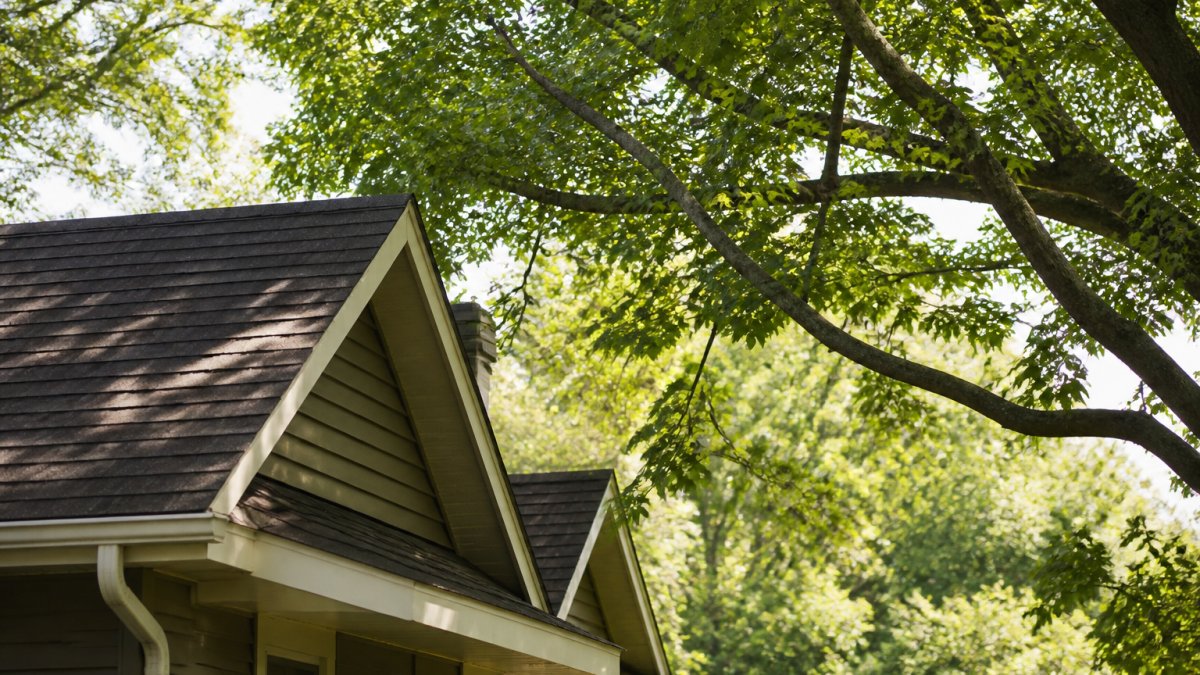
Tree trimming for roof protection starts with one simple fact: tree branches roof contact is already doing damage, even when nothing has fallen yet. The OSHA inspection guidance for tree-care operations treats overhead tree work as high-risk for a reason. Limbs near a roof fail without warning.
Homeowners may notice moss first, while branches can also pose a risk to the roof.
Here is what constant roof contact actually does:
- Scraping shingles. Wind pushes limbs back and forth. Each pass wears away the protective granules on asphalt shingles.
- Trapped debris. Leaves, twigs, and seeds pile up on the roof and in gutters. That blocks roof drainage.
- Moisture rot. Wet debris holds water against shingles and flashing. Rot follows.
- Limb weight. A heavy, wet branch resting on a roofline can crack decking or push flashing loose.
- Storm risk. Weak branches become falling branches in high wind.
A 2024 paper in Arboriculture & Urban Forestry found that trimming changes a tree's crown structure and mass distribution. That changes how the tree handles wind. Cut carelessly and you can make a tree more top-heavy, not less.
Storm-broken or hanging limbs over a roof need fast attention. For reliable emergency tree service in Penn Hills, help is available for fallen trees, storm damage, and hanging limbs. Fallen trees and hanging limbs need prompt attention.
How Far Should Tree Branches Be From Roof Surfaces?
The appropriate clearance depends on the tree and the property.
Roof clearance is the open air space between a tree limb and any roof surface. It is not a suggestion. It is the line between preventive maintenance and repair bills.
| Situation | Minimum Clearance | Why It Matters |
|---|---|---|
| Small ornamental trees | 3-6 feet | Limits scraping and debris drop |
| Medium shade trees | 6-10 feet | Handles limb sway in wind |
| Large mature trees | 10+ feet | Prevents limb weight on the roofline |
| Trees near gutters | 6 feet plus | Keeps roof drainage clear |
| Tree-to-house distance | 20-30 feet at planting | Room for mature canopy spread |
Tree Pruning vs. Tree Trimming: What's the Difference?
Tree pruning is the selective removal of specific branches to improve tree health, structure, or safety. Tree trimming is the general cutting back of growth, usually for clearance or shape. Pruning protects the tree. Trimming keeps it out of the way.
The distinction matters because pruning cuts should be made carefully.
For a deeper look at proper cuts and timing, read our guide to the best tree trimming techniques for health.
Step-by-Step: How to Prevent Roof Damage From Trees
Prevention is a routine, not a one-time job. The sequence below combines inspection, a clear DIY-versus-professional decision, proper pruning mechanics, and roof protection during the work. Follow it each year.
Step 1: Inspect the canopy from the ground
Walk the perimeter of the house and look up. You are checking for four things: limbs touching or within six feet of the roof, dead or hanging branches, cracks or splits at limb unions, and fungal growth at the base or on limbs. Binoculars help on tall trees. Note anything that has changed since last season.
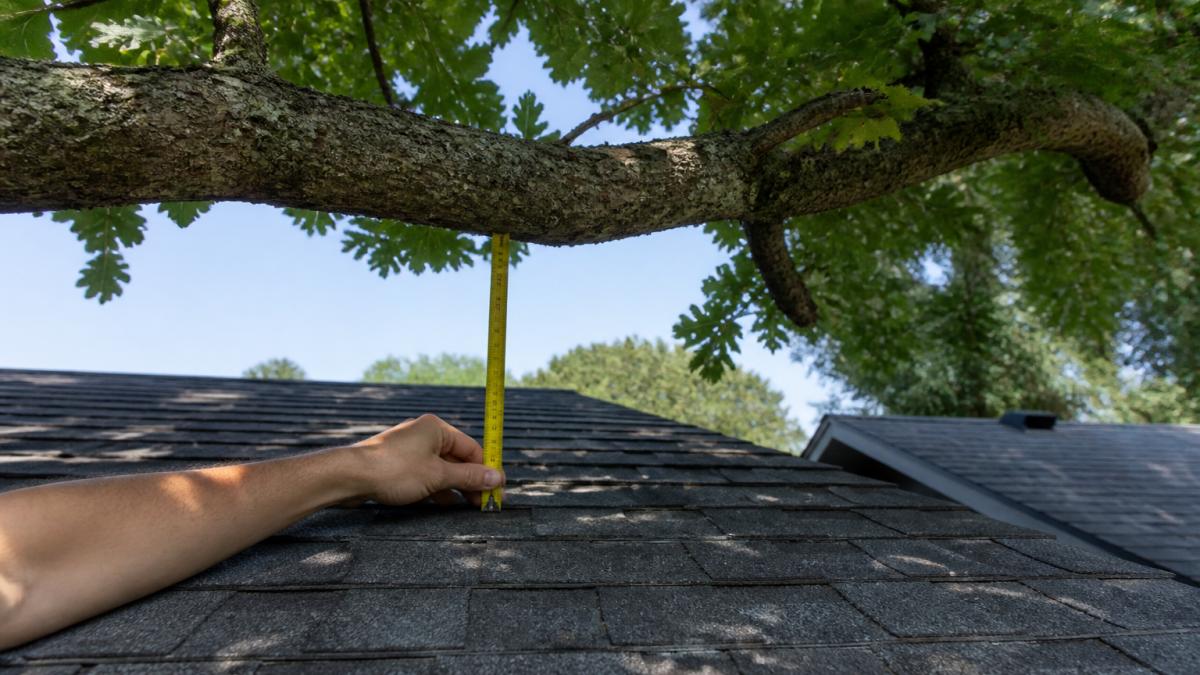
Step 2: Measure the gap
Use a tape measure or a long pole to estimate clearance between the lowest limb and the roof surface. If clearance is under six feet, plan a trim. For large mature trees with long, heavy limbs, target six to ten feet so wind sway does not bring the limb back into contact.
Step 3: Decide whether the branch is a DIY job or a professional job
A common pattern is for homeowners to underestimate limb weight. A 10-foot limb can weigh well over 100 pounds, and a limb that shifts while you are on a ladder can take you with it. Roof-adjacent work is not a ladder job.
Step 4: Make the cut correctly
If you are handling a small, accessible branch, protect the tree as well as the roof:
- Locate the branch collar. It is the swollen ring where the limb meets the parent branch or trunk.
- Make a shallow undercut about 6 to 12 inches out from the collar to prevent bark tearing as the limb falls.
- Cut from the top just outside the undercut to remove the bulk of the limb.
- Make the final cut just outside the branch collar, not flush with the trunk. Leaving the collar intact lets the tree seal the wound.
- Never top the tree. Topping invites weak, fast regrowth that breaks easily in wind.
- Keep total removal under 20% of live canopy in a single season to avoid stressing the tree.
Step 5: Protect the roof and property during the work
Before any cut, lay tarps over the roof section below the work area and over gutters, landscaping, and walkways. Direct falling limbs away from the roof where possible. Never drop a limb onto shingles; lower it with a rope if you can. After the work, clear gutters and sweep the roof surface so leaves and twigs do not trap moisture.
Step 6: Schedule trimming for late winter or early spring
For most species, dormant-season pruning is best: wounds close faster once growth resumes and the tree is under less stress. Avoid heavy cuts during active growth, extreme heat, or drought. Check for active nests before any cut.
Step 7: Book a roof inspection after major storms
Catch cracked flashing, lifted shingles, and granule loss early. A roof inspection after a storm is cheaper than a repair.
Step 8: Haul the debris away
Piles of cut branches near the house can hold moisture. Dependable tree debris hauling in Penn Hills clears brush, branches, logs, and storm wreckage.
When to Trim Branches Near a Roof (and When Not To)
When not to trim:
There is a contrarian point worth making here. Not every branch over a roof needs to come off. Tree Care Industry Magazine argues that pruning should cut specific risks without stripping canopy. Well-managed trees often protect homes more than they threaten them. Broad canopy removal is not the default answer.
Professional Tree Trimming Services: When to Call an Arborist
A professional tree trimming crew can help with branches over roofs and pruning to protect property.
The OSHA guidance on line-clearance tree trimming draws a hard line around work near energized lines. Covered operations fall under specific medical-services requirements. That is not a job for a homeowner with a pole saw.
Permits, boundary trees, and utility-line responsibility
Before you book anyone, answer three questions that most guides skip:
- Does the work require a permit? Many municipalities require a permit to remove or heavily prune certain trees, especially mature shade trees or trees in a right-of-way. Ask the arborist whether a permit is needed and who pulls it.
- Who owns the tree? If the trunk sits on the property line, it is a boundary tree and both owners usually share responsibility. If the trunk is on a neighbor's property but limbs hang over yours, you generally may trim back to the property line, but local rules vary. Get the boundary confirmed before cutting.
- Who is responsible near utility lines? Utility companies typically own and maintain clearance in their easements. Do not trim within 10 feet of a power line yourself; call the utility or a line-clearance qualified contractor.
What to check before you hire
- Proof of licensing and insurance, in writing
- Who actually shows up: their crew or subcontractors
Industry coverage from NIP Group's 2026 tree-care outlook points to labor shortages and rising claims as pressures shaping the year. Fewer qualified crews and more injury claims mean one thing for homeowners: verify licensing and insurance before anyone climbs.
Hilltop Tree Services LLC is family-owned, licensed, and insured, with over 15 years of experience and no subcontractors. You can see our professional tree trimming in Penn Hills and what it covers.
The business count tells its own story. IBISWorld reports 19,929 tree-trimming businesses in 2026, up 1.0% from 2025 (IBISWorld industry data). More providers means more noise. Licensing, insurance, and permit clarity are how you cut through it.
Get a Free Quote for Roof-Safe Tree Trimming
Every roof has a different tree problem. A mature oak needs different clearance than a young maple. A storm-damaged limb needs a different response than routine maintenance.
Pricing depends on the job. Contact Hilltop Tree Services LLC for a quote.
Our customers keep coming back for the same reasons. One put it simply: "Hilltop Tree service is completely reliable, professional, and affordable." Another noted the crew "came as promised and was very professional and easy to work with."
Frequently Asked Questions
Can branches touching a roof damage shingles?
Yes. Branches touching a roof can pose a risk to the roof. Contact Hilltop Tree Services LLC for a quote on trimming to protect your property.
How often should trees near a house be trimmed?
The appropriate trimming schedule depends on the tree and the property. Contact Hilltop Tree Services LLC for a quote on tree trimming.
What is the difference between tree pruning and tree trimming?
Tree trimming can include selective pruning to protect property, roofs, and power lines.
Should I hire an arborist to trim branches over my roof?
For branches over a roof, contact a professional tree trimming service for a quote.
Your roof is only as protected as the branches above it. If limbs are touching shingles or hanging over the roofline, get them assessed before the next storm does it for you. Hilltop Tree Services LLC brings licensed, insured crews, direct communication with the people doing the work, and full site cleanup when the job is done. Get started with Hilltop Tree Services LLC and request your free quote for roof-safe trimming today.


Get Your Free Quote
Join the 500+ homeowners who trust us with their tree services. Contact us to get a free quote for your project.


