 (412) 607-8548

Tree Maintenance for Hillside Properties: A Complete Guide
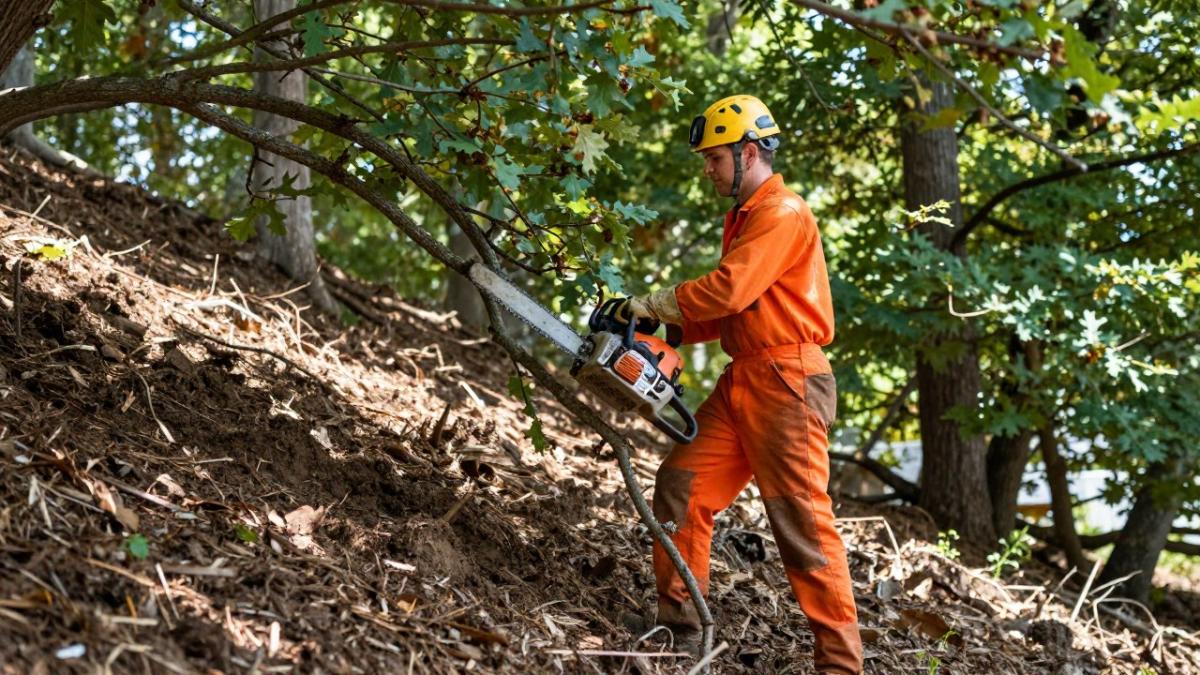
Last Updated: November 7, 2026
Quick Summary
Effective tree maintenance for hillside properties starts with measuring slope grade and checking soil depth, exposed roots, water paths, and lean before any work begins. On steep ground, prune in late winter, remove live growth sparingly, and use rigging rather than felling. Stabilize bare soil immediately after any removal.
- Slope percentage is rise divided by run; above 25% is steep and complicates equipment access and erosion.
- Limit live growth removal to roughly a quarter of the canopy in a single year.
- Never top a hillside tree, since the flush cut cannot seal and regrowth is weakly attached.
- Spread coarse mulch or erosion control matting the same day a tree comes down.
- Refresh mulch in spring before the summer dry spell rather than in fall.
Table of Contents
- Why Hillside Tree Maintenance Is Different From Flat-Yard Care
- Assessing Slope Grade and Site Conditions Before You Touch a Tree
- Best Trees for Hillside Erosion Control
- Pruning Hillside Trees: Methods, Timing, and Canopy Balance
- Tree Removal on Steep Lots: Rigging, Safety, and Access
- Slope Stabilization After Tree Removal
- Low-Maintenance Hillside Landscaping Around Mature Trees
- Schedule a Hillside Tree Risk Assessment With Hilltop Tree Services
- Frequently Asked Questions
Why Hillside Tree Maintenance Is Different From Flat-Yard Care
A tree on a slope fails differently than a tree on flat ground. When roots let go on an incline, the whole root plate can shear downhill, and gravity does the rest.
Flat-yard care assumes stable soil. Hillside care assumes movement.
Hillside trees often get treated like lawn trees: inspections get skipped, and a problem is usually noticed only when a trunk starts leaning toward the house. Forest Service found that planting and maintenance practices, program management, and site characteristics all drive whether a tree establishes successfully (U.S. Forest Service study on urban tree establishment).
Three things change on an incline:
- Water moves. Rain runs off instead of soaking in, so trees dry out faster, and the soil that holds them erodes.
- Roots hold less. Deep anchoring roots need depth. A shallow soil layer over rock or clay gives them nowhere to grip.
- Access is limited. Equipment cannot drive up a 30% grade, so every job becomes manual, slower, and more careful.
Below, we break down what to check, what to plant, how to prune and remove safely, and how to keep a slope from sliding after a tree comes out.
Assessing Slope Grade and Site Conditions Before You Touch a Tree
Start by measuring the incline, because slope grade decides everything that follows. Slope percentage is rise divided by run: a 10-foot rise over 100 feet of horizontal distance is a 10% grade (To Determine Percent of Slope and Angle of Slope).
Walk the slope and note these conditions before any work:
- Soil depth and texture. Push a soil probe or a sharpened dowel in. If it stops on rock a few inches down, roots are shallow and anchoring is weak.
- Exposed roots. Roots showing above the soil line on the downhill side signal erosion has already stripped the topsoil.
- Water paths. Look for channels, moss lines, and bare gravel where runoff concentrates. Trees sitting in a drainage path get loosened soil.
- Leaning. A lean toward downhill can be natural. A lean that has developed recently, or soil cracking at the base on the uphill side, is a warning sign.
- Canopy balance. Trees on a slope often grow lopsided toward the light, which loads weight on one side.
Watch out: a fresh crack in the soil around the base of a leaning hillside tree means the root plate is moving. Do not park under it, do not cut it yourself, and get a professional assessment before anything else happens.
Slope grade sets the terms for everything that follows, so measure it first and then check the site conditions below.
| Slope grade | Classification | What it means |
|---|---|---|
| Under 15% | Gentle | Equipment access and erosion are manageable |
| Above 25% | Steep | Equipment access and erosion become serious concerns |
| 10-foot rise over 100 feet | 10% grade | Rise divided by run gives slope percentage |
Best Trees for Hillside Erosion Control
The best trees for hillside erosion control are native species with deep or spreading root systems that hold soil through winter storms.
Deep taproots anchor. Spreading fibrous roots knit the topsoil into a mat. Both help, and a mix of the two across a slope works better than one species planted wall to wall.
Good candidates for slopes in this region include:
- Oaks, which develop strong anchoring roots and tolerate dry ridges.
- Hickories, deep-rooted and slow but exceptionally stable.
- Serviceberry and dogwood, smaller understory trees whose spreading roots hold soil on moderate grades.
Pair trees with groundcover and shrubs on the bare stretches between them.
Pruning Hillside Trees: Methods, Timing, and Canopy Balance
Prune hillside trees to remove dead weight and rebalance the canopy, not to shrink the tree.
Late winter, while trees are dormant, is the safest window for structural pruning.
On a slope, the pruning method matters as much as the timing:
- Crown thinning removes selected interior limbs to let wind pass through the canopy instead of pushing against it.
- Deadwood removal takes out the limbs most likely to fall on a roof, deck, or driveway below.
- Clearance pruning lifts low limbs away from structures and lines.
Watch out: topping a hillside tree to reduce its height creates a flush cut the tree cannot seal, and the fast regrowth that follows is weakly attached.
professional tree trimming in Penn Hills with the rigging and access a hillside requires.
Tree Removal on Steep Lots: Rigging, Safety, and Access
Tree removal on steep lots is a rigging job, not a climbing-and-dropping job. When there is no room to fell a tree and no flat ground for a bucket truck, the crew lowers every piece on ropes to a controlled drop zone.
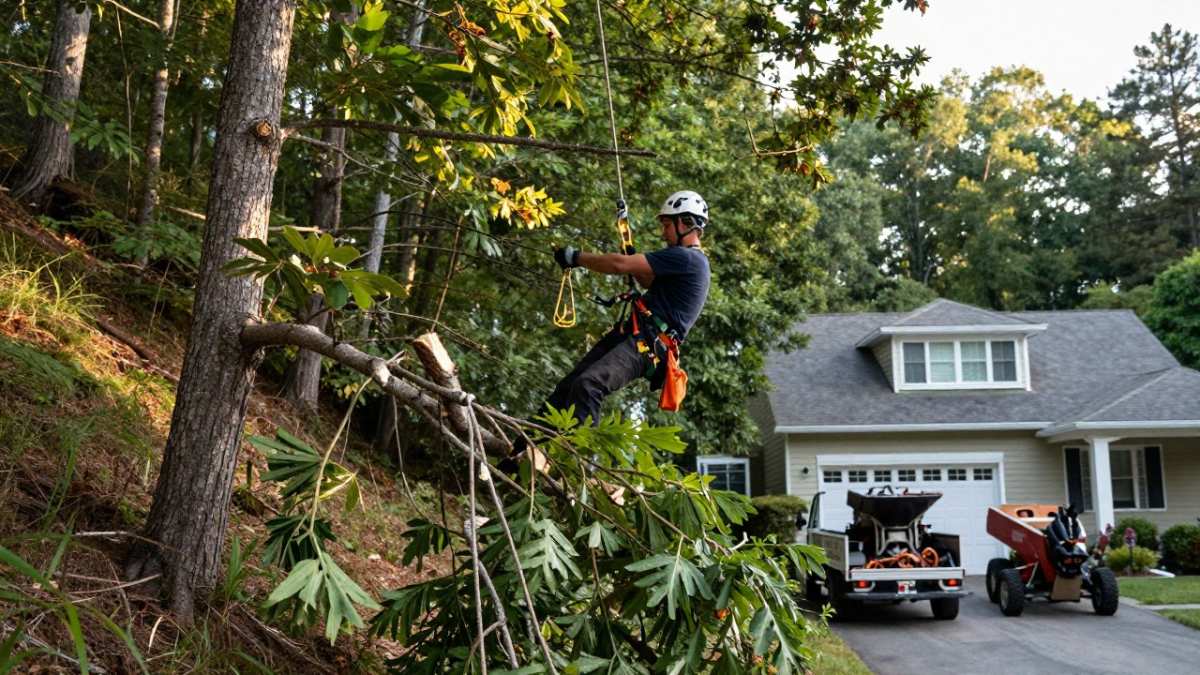
The process usually runs like this:
- Assess the tree and the slope. Identify the lean, the decay, the target zone below, and the anchor points for rigging.
- Set the rigging. A climbing arborist works the tree while a ground crew controls ropes and friction devices to lower limbs and trunk sections.
- Control the fall zone. Every piece lands where the crew decides, not where gravity decides.
- Chip and haul. Brush goes through a chipper staged on the flattest accessible ground, often the driveway.
Not sure whether a slope tree has crossed the line from risky to removable? Our guide to the signs a mature tree needs removal covers the warning signs, and our crew handles expert tree removal in Penn Hills for dead, leaning, and storm-damaged trees on difficult terrain.
Slope Stabilization After Tree Removal
Removing a tree takes away the roots that were holding that patch of hillside, so stabilization has to follow immediately. Leave a bare slope and the next heavy rain starts carving channels through it.
Plan the restoration before the saw comes out, and sequence it in this order:
- Stabilize the soil surface first. Spread coarse mulch or install erosion control matting over the bare patch the same day the tree comes down. Matting pinned to the slope holds seed and soil in place while vegetation establishes; loose straw blows away and loose mulch can float off in a heavy rain. On steeper ground, a shallow diversion, a small swale or berm on the uphill side of the bare patch, steers runoff around the disturbance instead of through it.
- Deal with the stump deliberately. Grind the stump below grade so the area can be regraded and replanted rather than left with a rotting pocket that collects water. If a stump is staying behind, our skilled stump grinding in Penn Hills takes it below the surface and clears the surface roots. A stump left flush on a slope becomes a void as the wood breaks down, and water finds that void.
- Replant quickly with the right root architecture. Replace the lost root mass with deep-rooted native species and a groundcover layer, not just a single replacement tree. A mix of groundcover, shrubs, and understory trees knits the soil at several depths, which is what actually holds a slope through the first wet season.
- Monitor through at least one full wet season. Check after the first heavy storms for new cracks, rills, settling, or soil pulling away from the base of remaining trees.
Watch out: a fresh crack in the soil around the base of a leaning hillside tree means the root plate is moving.
Stabilization is also where slope-specific tree risk assessment belongs.
Low-Maintenance Hillside Landscaping Around Mature Trees
Low-maintenance hillside landscaping works with the slope instead of fighting it.
Mulch is the cheapest tool on a slope. A ring of coarse mulch around each tree slows runoff, holds moisture, and keeps mowers and string trimmers away from the trunk.
Layer the planting from the ground up:
- Groundcover to skin the bare soil and slow water.
- Shrubs whose roots knit the mid-slope.
- Understory trees for canopy without the weight of a full-size tree.
Route drainage deliberately. A shallow swale or a buried downspout extension that carries roof water past the trees prevents the concentrated flow that undercuts roots.
For ongoing care, a year-round calendar keeps hillside tree maintenance manageable and turns separate tasks into a routine:
- Late winter (dormant season): structural pruning and deadwood removal while the branch structure is visible and the tree is least stressed; inspect for lean, cracks, and exposed roots before spring growth hides them.
- Early spring: refresh mulch, check that drainage swales and downspout extensions are clear, and look for heaving or new rills after winter storms.
- Late spring through summer: watch for drought stress and pests, water newly planted slope trees deeply and infrequently rather than lightly and often, and keep string trimmers away from trunks.
Schedule a Hillside Tree Risk Assessment With Hilltop Tree Services
Every slope is different, and a tree that looks fine from the kitchen window can be one storm away from trouble.
Hilltop Tree Services LLC is family-owned, licensed, and insured, with more than 15 years of experience and over 500 customers served.
If you have a leaning tree, an exposed root plate, or a slope you are not sure about, get a free quote for your service and we will tell you honestly what needs doing and what can wait.
A hillside tree can look healthy right up until the ground gives way, and by then the decision is made for you.
Frequently Asked Questions
What is the 10/20/30 rule for trees and does it apply to hillsides?
The 10/20/30 rule is a spacing guideline: keep trees about 10 feet from a house, 20 feet between trunks, and 30 feet from other large trees. On a hillside, spacing matters even more because roots hold soil in place. Crowded trees compete for water and nutrients, and their canopies shade out the understory that helps slow runoff. If your slope is steep, lean toward the wider end of those distances and keep the outer root zone undisturbed.
What are the best trees for hillside erosion control?
Look for native species with deep or spreading root systems and tolerance for dry, sloped ground. Oaks, hickories, eastern redbud, and serviceberry are solid choices in the Pittsburgh region. On steeper grades, combine trees with shrubs like ninebark and native groundcover so the slope has roots at multiple depths. Avoid shallow-rooted species and any tree that needs constant watering; a hillside tree that fails to establish leaves bare soil exposed to runoff.
Do trees actually stabilize hillsides?
Yes, tree roots reinforce soil and take up water that would otherwise saturate the slope. Stabilization depends on getting the tree established and keeping it healthy, since planting practices, maintenance, and site conditions all shape establishment. A dead or leaning tree stops helping and becomes a hazard, so routine hillside tree maintenance is what keeps the root system working.
Can removing trees from a slope cause erosion?
Removing trees does expose soil, and on a steep slope that can trigger runoff and shallow slides. The risk depends on how many trees come out, how steep the grade is, and how quickly you replace the lost root structure. Plan slope stabilization after tree removal before the crew leaves: leave stumps where practical, spread mulch, seed or plant the bare ground, and divert stormwater with a shallow swale or berm. A professional arborist can flag which trees must go and which can stay.
How can you tell if a hillside tree is at risk of falling?
Look for a leaning trunk that has shifted recently, exposed roots on the downhill side, cracked or heaving soil at the base, dead limbs in the canopy, and mushrooms or conks on the trunk. On a slope, the downhill root plate is the weak point, so any gap between the root flare and the soil is a warning sign. A tree risk assessment from a professional arborist is the reliable way to judge structural integrity before storm season.
When should a professional handle tree work on a hillside?
Any tree within falling distance of a house, power line, or neighbor's property is a job for a licensed and insured crew. Steep terrain adds rigging, limited access, and slope-specific safety risks that a homeowner cannot manage with a ladder and a chainsaw. If the trunk is leaning, the roots are exposed, or the tree is already dead, call a professional. Hilltop Tree Services LLC works with its own crew, with no subcontractors.


Get Your Free Quote
Join the 500+ homeowners who trust us with their tree services. Contact us to get a free quote for your project.


